Kneipp Spa in Bad Wörishofen: What is this Kneipp town known for?
Many visitors wonder which river flows through Bad Wörishofen . The answer is clear: Bad Wörishofen is traversed by the Wörthbach – a small stream in the Danube-Iller region of Swabia. The Wörthbach is a tributary of the Mindel and, as the town’s main stream, shapes the character of the spa town. The following article provides all the essential information about the course of the Wörthbach, its tributaries, and its significance for the Kneipp spa town.
Wörthbach: Course and characteristics
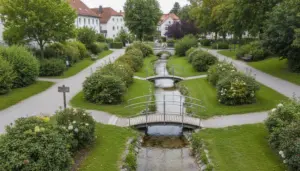
The Wörthbach stream originates in the Allgäu region and flows north from the Ostallgäu. Initially known as the Friesenrieder Bach, it merges with another headstream near Blöcktach to form the Wörthbach. From there, the stream, now called the Allgäuer Bach , flows through several villages before reaching Bad Wörishofen in the Unterallgäu district. Within the town itself, the Wörthbach meanders picturesquely through the spa gardens and the town center. It then continues north through the villages of Oberrammingen and Unterrammingen. Where does the Wörthbach flow to? It finally empties into the Flossach from the left near Unterrammingen. The Flossach is only a few kilometers long at this point and carries the Wörthbach’s water to the Mindel River – a tributary of the Danube. Thus, the Wörthbach is part of the Danube’s catchment area. In total, the Wörthbach, including its headstream, reaches a length of approximately 34.5 km and drains an area of about 134 km². Despite its considerable size, it is a comparatively small river that lives up to its name as a stream .
Tributaries Stutweidbach and Fehlbach in Bad Wörishofen
Besides the main river, the Wörthbach, there are other bodies of water within the town limits . The most important tributary is the Stutweidbach , which flows into the Wörthbach from the east in Bad Wörishofen. The Stutweidbach is approximately 4.6 km long and drains a catchment area of around 8 km². Another watercourse is the Fehlbach , a left branch of the Wörthbach. The Fehlbach branches off from the Wörthbach and flows through parts of the town before rejoining the main stream (its length is short, as it essentially forms a side channel). What is the name of the stream in Bad Wörishofen? Of course, all these names refer to the same body of water: the stream flowing through the town is called the Wörthbach. Both the Stutweidbach and the Fehlbach feed into or flow alongside the Wörthbach and shape the hydrological landscape of the spa town. The Wörthbach stream flows through Bad Wörishofen as the main watercourse, supported by these smaller tributaries and branches.
 Wörthbach in the spa town: Nature and significance
Tips:
When you visit Bad Wörishofen, be sure to plan a walk along the Wörthbach stream in the spa park. There you can enjoy Kneipp therapy at the various facilities and soak up the peaceful atmosphere by the babbling brook – a truly beneficial experience for both body and soul.
Summary:
The Wörthbach stream is not just a watercourse, but also an important part of the Kneipp tradition in Bad Wörishofen. It flows through the spa park and is used for water treatments. As a natural element, the stream contributes to the idyllic spa town atmosphere and offers visitors and locals alike places to relax right by the water.
Fact: Bad Wörishofen lies on the Wörthbach, a tributary of the Mindel. The Wörthbach’s water flows via the Flossach and Mindel rivers ultimately into the Danube – thus, the town’s stream is part of the extensive Danube river system.

